Blog
How to Grow Larkspur ‘Misty Lavender’ from Seed

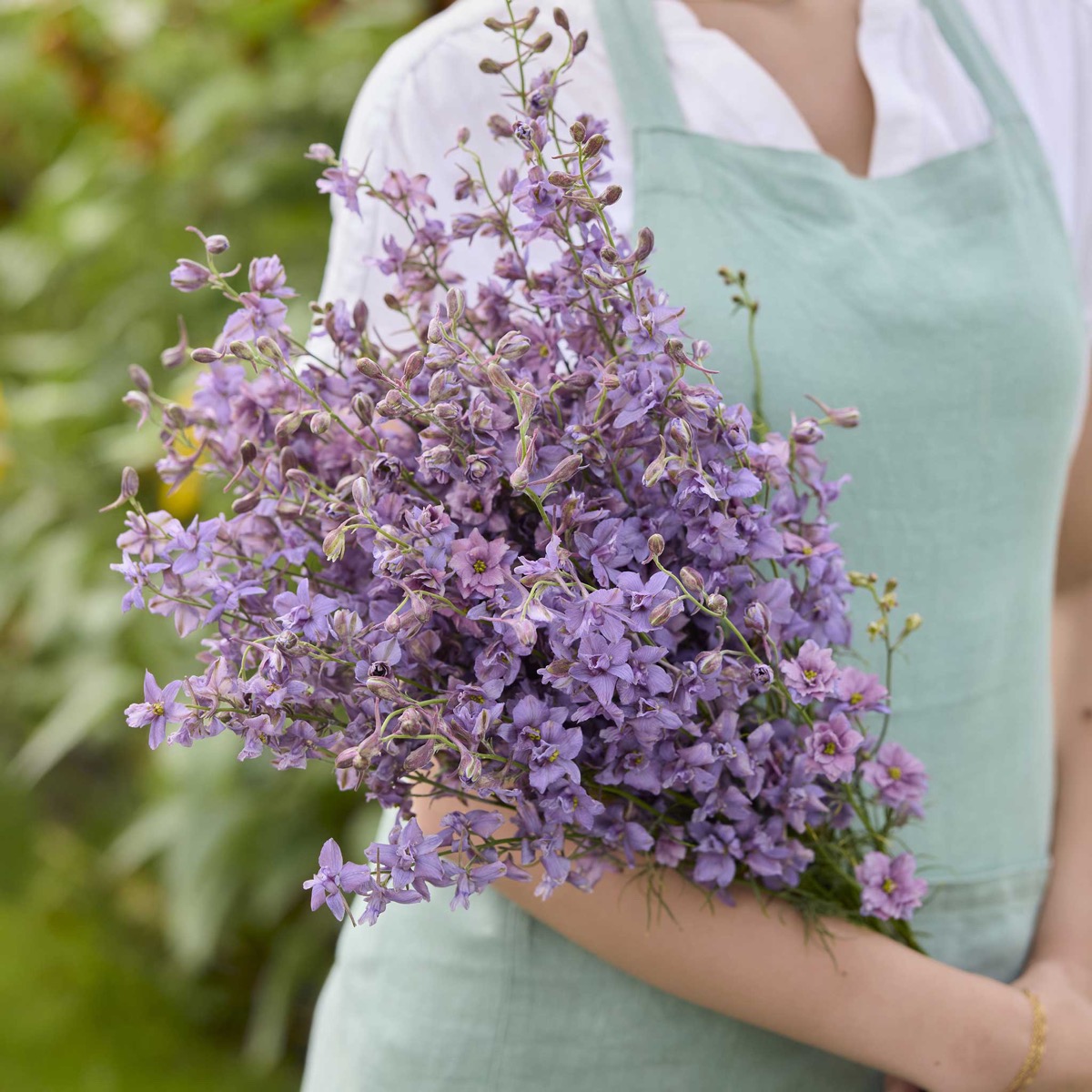
Larkspur ‘Misty Lavender’ is a hardy annual, and the most useful thing to know about growing it from seed is this: it germinates best after cold, and it hates being moved. Sow it directly where it is to flower — in fall if your winters are mild, in early spring if they are not — cover the seed with about 6 mm (¼ in) of soil, and thin the seedlings to roughly 30 cm (12 in) apart. Plants reach around 1 m (39 in), flower through summer, and hold up well in a vase.
Why larkspur wants cold, not warmth
Larkspur is an annual in the buttercup family, botanically Consolida ajacis — you will also see it sold as Delphinium consolida or Consolida ambigua. A hardy annual completes its whole life in one year and can survive frost once established: the RHS puts larkspur in the group that needs no winter protection in most of the UK.
The interesting part is germination. Larkspur seed is slow to germinate and benefits from cold, moist stratification. Utah State University Extension, which trialled larkspur for cut flower production in 2023 and 2024, puts it plainly: seed sown in fall gets that stratification naturally, while spring-sown seed should be chilled dry at 35–40 °F (2–4 °C) for three weeks beforehand.
Two consequences follow. Cover the seed — USU’s guidance is to sow ¼ in deep and make sure the seeds are covered, and the RHS says the same for autumn-sown hardy annuals. And do not plan on transplanting: larkspur grows a taproot, and USU notes that raising plugs indoors “can introduce challenges with taproot development and transplant establishment.”
When to sow ‘Misty Lavender’ where you live
The RHS rule for hardy annuals is to sow when the soil is moist, in September and October — and autumn-sown plants flower earlier than spring-sown ones. The trade-off, again from USU, is that overwintering is less predictable and can reduce germination. Which side you take depends on your winter.
United States
- Zones 7–10: sow September into November. Larkspur’s natural rhythm, and the earliest bloom.
- Zones 5–6: sow early September so seedlings size up before hard frost, or sow in spring as soon as the ground can be worked. Keep fleece or a cloche for hard freezes.
- Zones 3–4: spring sowing is safer. If you fall-sow, expect losses and protect the bed.
United Kingdom and Ireland
September and October, direct into a prepared bed. Northern parts of the UK — or any harsh winter — may need cloches or fleece during cold snaps.
Continental Europe and the Mediterranean
Europe is not one climate, and USDA zones do not map onto it cleanly — use your own last-frost date instead. Along the Atlantic seaboard the autumn window behaves much as in the UK. Inland and further east, where the ground freezes and thaws repeatedly, spring sowing after the last frost is more reliable. Around the Mediterranean, autumn is the natural season: sow October to November and the plants flower in spring.
How to direct-sow larkspur, step by step
- Choose the right spot. Full sun, light soil that drains freely. The RHS is blunt about two failure modes: avoid shady sites, and do not feed, because rich soil “may encourage leaves at the expense of flowers.”
- Clear the ground and rake to a fine, level tilth. USU lists weed competition as a direct limit on larkspur survival, and seed needs soil particles that will close around it — with no hollows where water pools and rots it.
- Sow 6 mm (¼ in) deep and cover the seed — broadcast thinly and rake soil over the top, or sow in shallow drills. Do not leave seed on the surface.
- Water gently with a fine rose if the soil is dry. Autumn rain usually handles the rest.
- Thin once you can see the seedlings. USU recommends sowing at three times your target density to guarantee a stand, then thinning. For display and cutting, thin to about 30 cm (12 in) apart — the spacing on the seed listing.
- Keep fleece to hand for cold snaps, as the RHS advises for autumn-sown hardy annuals.
Growing on: sun, support and the transplant trap
What larkspur needs beyond sun and free-draining soil is support. ‘Misty Lavender’ is a tall selection — the grower’s listing gives 39 in (about 1 m) — and the RHS advises staking taller plants to stop the stems flopping. On an exposed site, USU’s approach is a horizontal trellis or netting, which also keeps stems straight for cutting.
Cutting ‘Misty Lavender’ for the vase
Cut when a quarter to a third of the florets on a spike have opened — USU’s harvest standard — in the early morning, straight into a bucket of cool water. Handle the stems gently; they tip over and bruise easily.
Cutting regularly means more flowers. The RHS notes that annual delphiniums and larkspur “make long lasting cut flowers and, with regular picking, will go on producing further flower spikes well into autumn.” USU gives an expected vase life of 8–10 days with preservative and at least one water change. The stems also dry well.
What usually goes wrong
- Nothing comes up. Almost always soil conditions or sowing depth. USU flags that germination is difficult when soil is too dry or too wet.
- Seedlings collapse at the base. Damping off — the classic problem for freshly sown annuals, and a sign of overcrowding and wet, still air.
- Slugs and snails. USU’s trials documented slug damage on newly germinated plants with the true leaves chewed off.
- Powdery mildew. The main foliar disease in larkspur production. Good spacing and airflow help; remove spent stems after frost.
- Floppy, leafy plants with few flowers. Usually too much shade, too much fertility, or no support — the three things the RHS singles out.
A safety note before you plant
Larkspur is toxic. The NC State Extension Gardener Plant Toolbox records delphinium and larkspur as having high-severity poison characteristics, with all parts toxic to humans and pets if eaten, and the RHS notes that all parts, including the seed, are harmful if eaten and advises wearing gloves when handling. Keep the seed packet away from children and animals.
Frequently asked questions
How long does larkspur take to flower from seed?
The grower’s listing gives roughly 90 days from sowing to bloom. Autumn sowings overwinter as small plants and resume the moment conditions allow, so they flower earlier than spring sowings.
Will ‘Misty Lavender’ come back every year?
No — it is an annual, so each plant flowers once and dies at the end of its season. It will often self-seed if you leave a few spikes to ripen, but treat those volunteers as a bonus.
Do larkspur seeds need cold to germinate?
They germinate best after a cool, moist period. Fall sowing supplies it for free; for spring sowing, USU recommends chilling the seed dry at 35–40 °F (2–4 °C) for three weeks beforehand.
Growing it this season
‘Misty Lavender’ earns its place twice over: plum-coloured buds opening to ruffled mauve-lavender petals on stems tall enough to carry a border, and a vase life long enough to be worth cutting. Larkspur Seeds – Misty Lavender is the variety used throughout this guide, and it sits in our Annual Flower Seeds collection alongside cornflower, nigella and calendula — all happy with the same autumn sowing window.
Planning a whole bed rather than one variety? Start with Fall Sowing Hardy Annuals, and see How to Grow Sweet Pea ‘Royal White’ from Seed — sweet peas follow the same autumn logic. If you are weighing up starting any of it indoors, read that first.
Sources: RHS — Hardy Annuals: Sowing in Autumn; Annual delphiniums; Delphinium consolida (plant details). Volesky, N., & Stock, M. (2025), Larkspur Cut Flower Production in Utah, Utah State University Extension. NC State Extension Gardener Plant Toolbox — Delphinium.